Some buildings you leave quietly. Engine Shed was never going to be one of them.
On Friday 10 July, the doors opened for the Extravaganza – part send-off, part celebration, part last proper chance to be in this building together before it changes hands for good. Thirteen years of “try it and see,” of founders sleeping under desks and directors of property accidentally saying “our plan” instead of “his plan,” deserved exactly the kind of afternoon we got: loud, funny, a bit chaotic, and full of people who genuinely built something here.
Here’s what happened.
The Portrait No One Person Could Have Made
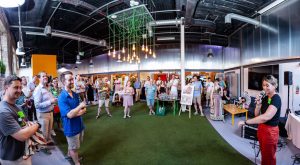
From 2pm, before a single word was said from the stage, guests were already building something together – a live art installation made entirely of memories. A meeting that changed everything. A company that started on a napkin. The person you met on your first day who you’re still working with now. Drink in hand, people added their bit to a growing collective portrait of Engine Shed, the exhibition – told in the words of the people who were actually here.
It’ll stay up for a fortnight before it becomes part of the archive. Engine Shed was never one story. It was always hundreds of small ones, happening at once.
The Main Stage, Hosted by Burt Williamson
Bristol comedy favourite Burt Williamson took the mic to open proceedings for the afternoon, and the energy stayed exactly where a Friday afternoon needs it to even though the building was extraordinarily hot.
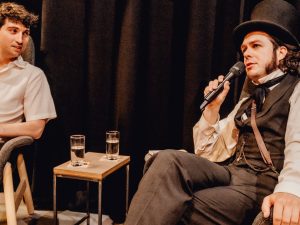
The Mr B Chat Show was a surprise highlight. Isambard Kingdom Brunel himself (well, a deeply knowledgeable impersonator) joined Burt for a live chat show that only really made sense in a building named after him. We heard about a childhood in Portsmouth and Hove, an education in France that ended with him sitting the entrance exam for the École Polytechnique, and a father, who taught him engineering through endless circle-drawing exercises and once spent 88 days in debtors’ prison after the British government failed to pay him for pulley blocks and army boots. Brunel’s chief residence, it turns out, was always Westminster – Bristol was work, not home. Which somehow made the stories about this city land even better.
He talked us through the Clifton Suspension Bridge – his “first child,” 33 years in the making, which he never lived to see finished – including the moment he crossed the unfinished span in a basket 250 feet up to free a jammed iron bar, then made it back in time for tea. He recounted losing the original Clifton competition to his rival Thomas Telford, only for Telford’s design to be judged too expensive and the whole thing re-run. He owned up to the Great Western Railway coming in at £6.5m against a £2.5m budget, and to backing a vacuum-powered railway that never worked and cost him dearly – persisting long after everyone told him to stop. Told with total sincerity, in a quickfire round, that his greatest regret was dying at 53 with so much left to build, and that if he were working today he’d be in aviation and ecological transport.
Then came Poulet Vino, Bristol’s finest improv collective, hosted by Theo Worsley with Ste Brown, Holly Meechan, Ros Beeson and Gemma Revell bringing decades of Bristol improv between them. Fast, funny, entirely unpredictable, and built entirely on suggestions shouted from the crowd. (You can find them on Instagram at @poulet_vino or at the Bristol Improv Theatre if you want more.)
The Pub Table: The Last Proper Conversation in This Building
At 4:15pm, the pop up pub, The Founders Arms opened for business, for 90 minutes only. Six people who were genuinely part of Engine Shed pulled up a chair – a landlady, a builder, a founder, a community voice, an innovator and a wildcard – for the headline moment of the afternoon. No slides, no prepared remarks, just honest conversation about what happened here, what people would do differently, and what Bristol needs next. Hosted by Briony, it was the last thing standing between the room and the live music – and it earned its place.
What came out was, in a way, the whole story of Engine Shed. There was never a formal business plan. It started as passion projects and free time and no money, and it started almost by accident – Nick pitching “Creative Harbour,” the idea that became Engine Shed, at a 2012 University Enterprise Dinner after a scheduled speaker dropped out. The story goes that the Vice Chancellor accidentally said “our plan” instead of “his plan,” and from there the council’s Director of Property and the university’s CFO each assumed the other had already signed off. Somehow, it happened. Engine Shed was fitted out (all 30,000 square feet of it) for £67,000, against what would normally have cost the council or university closer to £200k. It was only ever meant to be temporary.
And then it just… became this. A waterfall through the ceiling onto a pile of laptops. A three-hour rooftop rescue for a bird tangled in netting. A giant robotic snail that filled the entrance to the ceiling during Bristol Tech Festival and occasionally hit the lights. Nick Clegg filming breakfast TV at 6am, then quietly stepping away to call his kids before school. Prince William talking mental health with the CEOs of Vodafone and Santander while 16 and 17 year olds on the other side of the glass carried on, completely unbothered. A stock photo library, built because one founder couldn’t find diverse images online, that went on to rack up 16,000 downloads and a spot on the BBC. Founders sleeping under desks. Sandwiches disappearing from boardroom events, one pocketful at a time.
None of it was strategy. It was values, trust, and instinct, an open-door policy that some early tenants actually resisted, because they wanted locked doors. As one voice at the table put it: culture eats strategy for breakfast.
That’s the piece everyone at the table circled back to when the conversation turned to what’s next. Engine Shed is moving into a university-owned building as part of Bristol Innovations. We talked about the possibility that initially it might be like a fancy house you’re almost afraid to touch. But the concern on the table wasn’t really about the building at all – it was whether policy, however well-intentioned, could crowd out the culture that made this place work. The comparison that stuck: Barcelona didn’t win its Olympic legacy by building shiny new stadiums, but by knocking things down and building town squares instead. What Bristol needs to complement the new building is a town square anyone can walk into.
There was optimism too. Briony was credited as one of the first people to reach out when a new arrival moved across from industry – exactly the kind of small, unglamorous act of welcome that built this place in the first place. And somebody has apparently already spotted a wine fridge on the top floor of the new building, which the room took, only half-jokingly, as a good sign.
After 5:30pm
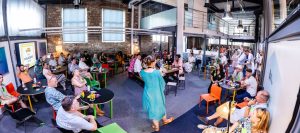
Before the lights go out for the final time in December, the doors opened one last time – for tenants, collaborators, regular attendees and quiet supporters alike. A proper send-off, with live music from Charlotte Coupland, karaoke, an open-mic stories session in the lounge for anyone who wanted to share their own Engine Shed memory, food from Sundial Kitchen and cupcakes from DidiCakes. Light-touch, funny, heartfelt, and exactly the kind of evening this building has always been good at.
What’s Next
Engine Shed will stay open as a venue and office space until December 2026, so this isn’t quite goodbye. But the Extravaganza was, in every meaningful sense, the last proper party in this building, and a fitting one.
There’s more to come. The Brunel Centre research project is now underway, looking at both the legacy of Engine Shed and the future of Bristol’s innovation ecosystem. They are building on the SQW report from ten years ago and Dr Laura Bennett’s PhD and subsequent book on innovation ecosystems. If you have been part of the Engine Shed journey, we’d love ten minutes of your time on the short survey to help shape that story.
Complete the Brunel Centre survey, it’ll take you 10 minutes: https://uniofbath.questionpro.eu/legacy-of-engine-shed
Thank you to everyone who came, who shared a memory, who stayed for the dancefloor. Thirteen years, and it still felt like the room wasn’t quite ready to say goodbye. That’s probably the whole point.